| |
|

The Fillmore’s heritage and rebirth
By GraceAnn Walden
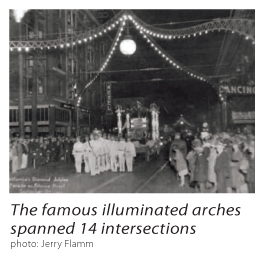 The Fillmore District south of Geary Boulevard means different things to San Franciscans, mostly depending on their age. To young rock and rollers, it’s where the Fillmore Auditorium is, a place to see everyone from Tower of Power to The Black Crows. To others, those who have lived here since the 1930s or before, the Fillmore corridor is remembered as adorned with curved metal arches, which were illuminated at night. In fact, it was thought to be the most brightly lighted street in America. The Fillmore District south of Geary Boulevard means different things to San Franciscans, mostly depending on their age. To young rock and rollers, it’s where the Fillmore Auditorium is, a place to see everyone from Tower of Power to The Black Crows. To others, those who have lived here since the 1930s or before, the Fillmore corridor is remembered as adorned with curved metal arches, which were illuminated at night. In fact, it was thought to be the most brightly lighted street in America.
When I came to San Francisco in the early 1970s, most of it looked like an A-bomb had leveled it. I learned that the Fillmore was an African-American neighborhood that had been the focus of urban renewal since the 1950s.
The fight to stop the buying up and destruction of buildings and businesses went on for years. The social democrats I met called the clear-cutting of the Fillmore “Negro Removal.” They fought with residents against it.
Today a renaissance of sorts is underway – more about that later.
To understand the entire history of the Fillmore, we need to start at the beginning.
After the Gold Rush, San Francisco was a burgeoning city. Needing more land to expand, the government laid out hundreds of blocks west of Larkin Street and named it the Western Addition.
 Victorians were built and the main thoroughfare, Fillmore, became the heart of the commercial district. The inhabitants were mostly Jewish who tended small farms and vegetable gardens. Over time, more Jewish residents settled in the Fillmore, building three synagogues, a cultural center, plus dozens of Kosher butchers, food shops and bakeries. Noted Jewish performers, such as Yehudi Menuhin, the honored violinist, and Mel Blanc, the voice of Bugs Bunny and hundreds of other characters from the cartoon world, both came from the Fillmore. Victorians were built and the main thoroughfare, Fillmore, became the heart of the commercial district. The inhabitants were mostly Jewish who tended small farms and vegetable gardens. Over time, more Jewish residents settled in the Fillmore, building three synagogues, a cultural center, plus dozens of Kosher butchers, food shops and bakeries. Noted Jewish performers, such as Yehudi Menuhin, the honored violinist, and Mel Blanc, the voice of Bugs Bunny and hundreds of other characters from the cartoon world, both came from the Fillmore.
After the Great Earthquake shook San Francisco in 1906 and the City burned for three days, most of the businesses on Market Street relocated to the largely undamaged Fillmore Street. It became the new commercial hub of the City overnight. Eight movie theaters and a legitimate theater eventually lined it.
Filipinos, Mexicans, Japanese, Russians, and African-Americans, who couldn’t afford to live in the more expensive areas, settled in the Fillmore.
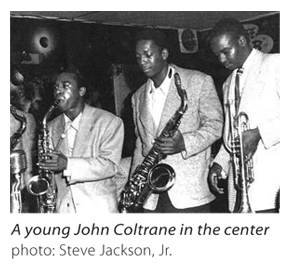
During World War II, African-Americans from the South migrated to the Bay Area to work in the shipyards and steel mills. They found affordable housing in the Fillmore. Their influx led to a great cultural explosion in the area, with many nightclubs featuring jazz music. Stars like Ella Fitzgerald, Louis Armstrong, Charlie Mingus, and Billie Holiday played the Fillmore clubs.
But as part of the war effort, the lighted arches that graced every intersection were melted down.
After the war, housing tracts were built in the suburbs and the white population from the Fillmore left the City for the American dream house. The aging housing stock in the Fillmore deteriorated under absentee landlords. More important, with wartime jobs closed, the African-American residents became poorer.
Meanwhile, Market Street had been rebuilt and was thriving.
In the 1950s, urban renewal projects boomed all over the country and San Francisco was no different. Eventually 60 square blocks were leveled, and 10,000 residents were displaced in the Fillmore. Despite their valiant fight, urban renewal was implemented; Geary Boulevard was widened, Kaiser Hospital and the Japanese Culture and Trade Center were built.
Much of the land lay fallow for two decades because investors didn’t want to back this neighborhood. Eventually, Mayor Feinstein supported the building of the Fillmore Center, which includes apartments and shops, but most of the original residents of the Fillmore couldn’t afford to rent there.
In 2000, the San Francisco Redevelopment agency created the Old Fillmore Jazz Preservation District in an effort to revitalize the area. It is a gift to the City. One highlight is the Jazz Heritage Center, which is part jazz museum, part jazz cultural center and part jazz art gallery.
Another gem is Yoshi’s Jazz Club and restaurant. Chef Sho Kamio creates some of the most authentic Japanese food in the City in a soaring space. I caught Boney Jones in a sold-out concert earlier this year. The club rivals the best New York Jazz club for comfort and sound.
Not far from Yoshi’s, is chef David Lawrence’s lovely 1300 on Fillmore. His cuisine is a modern take on southern food with dishes like fried green tomatoes with goat cheese and the best fried chicken.
In the surrounding area, one of my favorite places to enjoy a cocktail and a snack is the Sheba Piano Lounge. Tuck into a dish of drunken chicken drumettes, the pomegranate meatballs, an icy beer and some tinkling ivories for a good time.
Another jazz joint in the nabe is the Rassela’s Jazz Club & Restaurant, serving up cool sounds and spicy Ethiopian food.
With three jazz clubs, a handful of restaurants, and a gallery featuring jazz-related art, the Fillmore may be on its way to a rebirth.
Now, if they’d just bring back those lighted arches.
Jazz Heritage Center: 1320 Fillmore Street (near Eddy), 415-346-0961, www.jazheritagecenter.com
Yoshi’s: 1330 Fillmore Street (near Eddy), 415-655-5600, www.sf.yoshis.com
1300 on Fillmore: 1300 Fillmore Street (near Eddy), 415-771-7100, www.1300fillmore.com
Sheba’s Piano Lounge: 1419 Fillmore Street (near Ellis), 415-440-7414,
www.shebalounge.com
Rassela’s Jazz Club: 1534 Fillmore Street (near Geary), 415-346-8698, www.rasselasjazzclub.com
GraceAnn Walden writes and leads tours of San Francisco neighborhoods. Visit www.graceannwalden.net for more information.


|
|
|
|